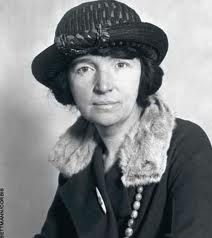
Margaret Sanger, the racist founder of Planned Parenthood, was an evolutionist who wanted to rid the earth of "human weeds,' 'reckless
breeders,' 'spawning... human beings who never should have been born."
She was heavily involved in the Eugenics movement, birth control & collaborated with certain Nazis. She hate blacks, the poor, and the "feeble minded"
Planned Parenthood still honors this wicked murderer today, annually giving an award in her name.
This depraved evil woman's name should be mentioned with the likes of Hitler, Stalin, Mao and other murderers of millions. But she is responsible for more death than all of them combined!
On blacks,
immigrants and indigents:
"...human weeds,' 'reckless
breeders,' 'spawning... human beings who never should have been born."
Margaret Sanger, Pivot of Civilization, referring to immigrants and poor people
On sterilization & racial purification:
Sanger believed that, for the purpose of racial
"purification," couples should be rewarded who chose
sterilization.
Birth Control in America, The Career of Margaret
Sanger, by David Kennedy, p. 117, quoting a 1923 Sanger speech.
On the right of married couples to bear children:
Couples should be required to submit applications to have a child,
she wrote in her "Plan for Peace."
Birth Control Review,
April 1932
On the purpose of birth control:
The purpose in promoting birth control was "to create a race of
thoroughbreds," she wrote in the
Birth Control Review, Nov.
1921 (p. 2)
On the rights of the handicapped and mentally ill, and racial
minorities:
"More children from the fit, less from the unfit -- that is the
chief aim of birth control."
Birth Control Review, May
1919, p. 12
On religious convictions regarding sex outside of marriage:
"This book aims to answer the needs expressed in thousands on thousands of letters to me in

the solution of marriage problems... Knowledge of sex truths frankly
and plainly presented cannot possibly injure healthy, normal, young
minds. Concealment, suppression, futile attempts to veil the unveilable -
these work injury, as they seldom succeed and only render those who
indulge in them ridiculous. For myself, I have full confidence in the
cleanliness, the open-mindedness, the promise of the younger
generation."
Margaret Sanger,
Happiness in Marriage (Bretano's, New York,
1927)
On the extermination of blacks:
"We do not want word to go out that we want to exterminate the Negro
population," she said, "if it ever occurs to any of their more
rebellious members."
Woman's Body, Woman's Right: A Social
History of Birth Control in America, by Linda Gordon
On respecting the rights of the mentally ill:
In her "Plan for Peace," Sanger outlined her strategy for
eradication of those she deemed "feebleminded." Among the
steps included in her evil scheme were immigration restrictions;
compulsory sterilization; segregation to a lifetime of farm work; etc.
Birth
Control Review, April 1932, p. 107
On adultery:
A woman's physical satisfaction was more important than any marriage
vow, Sanger believed.
Birth Control in America, p. 11
On marital sex:
"The marriage bed is the most degenerating influence in the
social order," Sanger said. (p. 23) [Quite the opposite of God's
view on the matter: "Marriage is honorable in all, and the bed
undefiled; but whoremongers and adulterers God will judge."
(Hebrews 13:4)
On abortion:
"Criminal' abortions arise from a perverted sex relationship under
the stress of economic necessity, and their greatest frequency is among
married women."
The Woman Rebel - No Gods, No Masters, May
1914, Vol. 1, No. 3.
On the YMCA and YWCA:
"...brothels of the Spirit and morgues of Freedom!"),
The
Woman Rebel - No Gods, No Masters, May 1914, Vol. 1, No. 3.
On the Catholic Church's view of contraception:
"...enforce SUBJUGATION by TURNING WOMAN INTO A MERE
INCUBATOR."
The Woman
Rebel - No Gods, No Masters, May 1914, Vol. 1, No. 3.
On motherhood:
"I cannot refrain from saying
that women must come to recognize there is some
function of womanhood
other than being a child-bearing machine."
What Every Girl Should
Know, by Margaret Sanger (Max Maisel, Publisher, 1915) [Jesus said: "Daughters of Jerusalem, weep... for your
children. For,
behold, the days are coming, in which they shall
say, Blessed (happy) are the barren, and the wombs that never bare,
and the breasts which never gave suck." (Luke 23:24)]
 "The most merciful thing that a large family does
to one of its infant members is to kill it." Margaret Sanger,
Women and the New Race (
"The most merciful thing that a large family does
to one of its infant members is to kill it." Margaret Sanger,
Women and the New Race (Eugenics Publ. Co., 1920, 1923)
Her goal in life:
Sanger admitted her entire life's purpose was to promote birth
control.
An Autobiography, p. 194
Helped to establish the research bureau that financed "the pill," she
contributed toward the work of the German doctor who developed the IUD. "Ernst Graefenberg and His Ring,"
Mt. Sinai Journal of
Medicine, July-Aug. 1975, p. 345, in
Margaret Sanger: Father of
Modern Society, by Elasah Drogin
Sanger espoused the thinking of eugenicists -- similar to Darwin's
"survival of the fittest" -- but related the concept to human
society, saying the genetic makeup of the poor, and minorities, for
example, was inferior.
Pivot of Civilization, by Margaret
Sanger, 1922, p. 80
On mandatory sterilization of the poor:
One of Sanger's greatest influences, sexologist/eugenicist Dr.
Havelock Ellis (with whom she had an affair, leading to her divorce from
her first husband), urged mandatory sterilization of the poor as a
prerequisite to receiving any public aid.
The Problem of Race
Regeneration, by Havelock Ellis, p. 65, in
Margaret Sanger:
Father of Modern Society, p. 18.
Ellis believed that any sex was acceptable, as long as it hurt no
one.
The Sage of Sex, A Life of Havelock Ellis, by Arthur
Calder-Marshall, p. 88
On eradicating 'bad stocks':
The goal of eugenicists is "to prevent the multiplication of bad
stocks," wrote Dr. Ernst Rudin in the April 1933
Birth Control
Review (of which Sanger was editor). Another article exhorted Americans to "restrict the
propagation of those physically, mentally and socially inadequate."
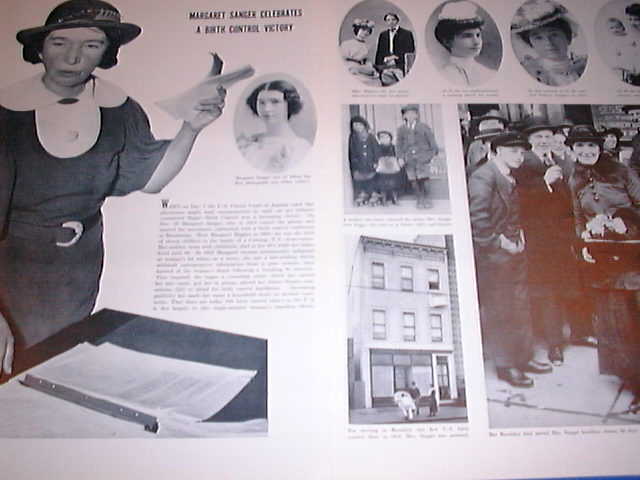
Sanger featured in Life magazine, 1937, "Margaret Sanger
celebrates Birth Control Victory."

Margaret Sanger Quotes, History, and Biography
By 1911, Sanger had moved to New York City, where she became heavily
influenced by anarchist, socialist, and labor activists. She began
joining and participating in radical groups and causes.
In March 1914, Sanger published the first issue of her own paper,
The Woman Rebel.
Along with providing information about birth control, Sanger
wholeheartedly supported the use of violence to achieve political,
economic, and social goals. Case in point, the
Lexington Avenue bombing.
On July 4th of that year, a bomb accidentally exploded in a Harlem
apartment, killing three men and one woman. The three men were planning
to bomb the home of industrialist John D. Rockefeller, but the bomb
exploded prematurely. The plan was devised at the Ferrer Center, an
educational institution, which also served as the meeting place for a
movement of radicals. Sanger lectured at the institution, and was active
in the movement.
After the failed terrorist attempt, Sanger wrote a
commentary,
calling the deaths a display of “courage, determination, conviction, a
spirit of defiance.” She argued the “real tragedy” was “the cowardice
and the poisonous respectability” of the movement’s leaders who offered
apologies, rather than defiance, for the episode. Sanger urged those in
the movement to “accept and exult in every act of revolt against
oppression,” including terrorist acts. She also published a
complementary article that defended the assassination of political or industrial leaders.
The following month, August 1914, Sanger was
indicted
for inciting murder and assassination, and for violating obscenity
laws. But instead of facing the charges, she fled the country. On the
trip to England, after the ship had entered international waters, Sanger
instructed her supporters to distribute 100,000 copies of her pamphlet,
Family Limitation. In February 1916, the charges were dropped.
In October 1916, Sanger
opened
America’s first birth control clinic. Located in Brownsville, New York,
the clinic permanently closed a month later, after Sanger was charged
with maintaining a public nuisance. In February 1917, she was convicted
and given a thirty day prison sentence.
Also in February 1917, the first issue of Sanger’s journal,
The Birth Control Review, was published. She was
The Review’s editor until 1929, and used her editorials to promote birth control and eugenics. For Sanger, these issues were inseparable.
The word
eugenics, which means
well born, was
coined in 1883 by Sir Francis Galton, a cousin of Charles Darwin.
Positive eugenics was a movement that attempted to “improve” the human
population by encouraging “fit” people to reproduce. Negative eugenics,
conversely, attempted to “improve” the human population by discouraging
“unfit” people from reproducing. The “unfit” people included the poor,
the sick, the disabled, and the “feeble-minded,” the “idiots,” the
“morons,” and the “insane.” And “discouragement” from reproducing
included the use of force.
Sanger rejected positive eugenics, while embracing negative eugenics. She
wrote,
“Like the advocates of Birth Control, the eugenists, for instance, are
seeking to assist the race toward the elimination of the unfit. Both are
seeking a single end but they lay emphasis upon different methods.” She
stressed the need to merge eugenics with birth control,
adding,
“Eugenics without Birth Control seems to us a house builded upon the
sands. It is at the mercy of the rising stream of the unfit.”
And Sanger advocated birth control backed up by forced sterilization or segregation to achieve her aims,
writing,
“While I personally believe in the sterilization of the feeble-minded,
the insane and syphilitic, I have not been able to discover that these
measures are more than superficial deterrents when applied to the
constantly growing stream of the unfit. They are excellent means of
meeting a certain phase of the situation, but I believe in regard to
these, as in regard to other eugenic means, that they do not go to the
bottom of the matter.” The bottom of the matter was “
to create a race of thoroughbreds.” So the government, Sanger
concluded,
needed “to apply a stern and rigid policy of sterilization and
segregation to that grade of population whose progeny is already
tainted, or whose inheritance is such that objectionable traits may be
transmitted to offspring” and “to give certain dysgenic groups in our
population their choice of segregation or sterilization.”
In her 1920 book,
Woman and the New Race,
Sanger wrote that birth control “is nothing more or less than the
facilitation of the process of weeding out the unfit, of preventing the
birth of defectives or of those who will become defectives.”
She had a plan. And she was about to get an organization. In 1921, Sanger
founded
the
American Birth Control League, which (following a 1939 merger with
the Birth Control Clinical Research Bureau and then a 1942 name change)
became the
Planned Parenthood Federation of America.
While the
organization was growing, the
close association between the birth
control movement and the eugenics movement had made a name change
necessary. Nazi Germany had implemented
racial hygiene
policies, including mass sterilizations, inspired by the eugenics
movement in America. So “birth control” was removed from the name to
create a new public image. The agenda, though, stayed the same. And in
1948, Sanger helped
form the
International Committee on Planned Parenthood, which (in 1952) became the
International Planned Parenthood Federation.
Through it all, the underlying theme, eliminating the unfit, never changed. In her 1922 book,
The Pivot of Civilization,
she attacked charity as counterproductive, and dangerous, for helping
the poor to produce even more “human waste.” (Sanger’s term for the
children of the poor.) She wrote,
“Organized charity is itself the
symptom of a malignant social disease.” And, “Instead of decreasing and
aiming to eliminate the stocks [of people] that are most detrimental to
the future of the race and the world, it tends to render them to a
menacing degree dominant.”
In a 1925 book,
Birth Control: Facts and Responsibilities,
Sanger contributed an essay, writing, “Birth Control is not merely an
individual problem; it is not merely a national question, it concerns
the whole wide world, the ultimate destiny of the human race. In his
last book, Mr. [H.G.] Wells speaks of the meaningless, aimless lives
which cram this world of ours, hordes of people who are born, who live,
yet who have done absolutely nothing to advance the race one iota. Their
lives are hopeless repetitions. All that they have said has been said
before; all that they have done has been done better before. Such human
weeds clog up the path, drain up the energies and the resources of this
little earth. We must clear the way for a better world; we must
cultivate our garden.”
Then in 1926, Sanger spoke at a Ku Klux Klan rally in Silver Lake, New Jersey. Writing about the event in her
autobiography, she highlighted its success, noting that “a dozen invitations to speak to similar groups” were offered.
And in 1939, Sanger went to work “cultivating the garden.” She initiated the
Negro Project
to weed out the unfit from the black population. In bringing birth
control to the then largely poor (i.e. unfit) population of the South,
with a few influential black ministers promoting the project as the
solution to poverty,
Sanger hoped to significantly reduce the black
population. Martin Luther King, Sr., as the eldest son of nine children
born into poverty in a family of sharecroppers, would have made the
perfect target for “elimination.” But his birth had already taken place.
In her later years, Sanger still believed that there were people “
who never should have been born at all.” In a 1957
interview
with Mike Wallace, she said, “I think the greatest sin in the world is
bringing children into the world – that have disease from their parents,
that have no chance in the world to be a human being practically.
Delinquents, prisoners, all sorts of things just marked when they’re
born. That to me is the greatest sin – that people can – can commit.”
Sanger’s impact during her lifetime was highly negative, and included
the cruelty of
forced sterilization, which became a common practice. In
America, over
60,000 people were sterilized against their will. And most occurred during the
1930s and 1940s
when Sanger and the birth control and population control movements were
pushing states hard to enact and enforce compulsory sterilization laws.
Among the
victims
were the blind, the deaf, epileptics, the mentally retarded, the
mentally ill, and people with low IQs diagnosed as “feeble-minded.”
Sanger’s legacy today, which is being carried on by Planned
Parenthood, includes the devastating impact of “birth control” on the
black community.
Planned Parenthood has continued the practice of
targeting the black population. Over 30% of all abortions are performed on black women and close to 40% of black pregnancies end in abortion.
Planned Parenthood successfully created a public image of an
organization working to help the poor, while hiding the reality that it
targets the vulnerable. That was Sanger’s plan from the start.
http://liveaction.org/research/margaret-sanger-quotes-history-and-biography
Margaret Sanger: An Autobiography
- 1938
- Eugenics, which had started long before my time, had once been
defined as including free love and prevention of conception... Recently
it had cropped up again in the form of selective breeding.
- Chapter 30, "Now Is the Time for Converse", p. 374.
- I accepted one branch of this philosophy, but eugenics without birth
control seemed to me a house built upon sands. It could not stand
against the furious winds of economic pressure which had buffeted into
partial or total helplessness a tremendous proportion of the human race.
The eugenists wanted to shift the birth control emphasis from less
children for the poor to more children for the rich. We went back of
that and sought first to stop the multiplication of the unfit. This
appeared the most important and greatest step towards race betterment.
- Chapter 30, "Now Is the Time for Converse", pp. 374-375.
- Always to me any aroused group was a good group, and therefore I
accepted an invitation to talk to the women's branch of the Ku Klux Klan
at Silver Lake, New Jersey, one of the weirdest experiences I had in
lecturing. . . Never before had I looked into a sea of faces like these.
I was sure that if I uttered one word, such as abortion, outside the
usual vocabulary of these women they would go off into hysteria. And so
my address that night had to be in the most elementary terms, as though I
were trying to make children understand. [npg] In the end, through
simple illustrations I believed I had accomplished my purpose. A dozen
invitations to speak to similar groups were proffered. The conversation
went on and on, and when we were finally through it was too late to
return to New York.
- Chapter 29, "While the Doctors Consult", p. 366.
Margaret Sanger, the alcoholic and Demerol addict, who spawned the International Planned Parenthood
Federation, was a proponent of forced eugenics, segregation, abortion, birth control and sexual
immorality. Here are some of her quotes.
"The most merciful thing that a family does to one of its infant members is to kill it."
Margaret Sanger, Founder of Planned Parenthood
"Birth control must lead ultimately to a cleaner race."
Margaret Sanger, Founder of Planned Parenthood
"We should hire three or four colored ministers, preferably with social-service backgrounds,
and with engaging personalities. The most successful educational approach to the Negro
is through a religious appeal. We don't want the word to go out that we want to exterminate
the Negro population…"
Margaret Sanger, Founder of Planned Parenthood
"Eugenic sterilization is an urgent need ... We must prevent multiplication of this bad stock."
Margaret Sanger, Founder of Planned Parenthood
"Eugenics is … the most adequate and thorough avenue to the solution of racial, political
and social problems.
Margaret Sanger, Founder of Planned Parenthood
"Birth control itself, often denounced as a violation of natural law,
is nothing more or less than the facilitation of the process of weeding
out the unfit, of preventing the birth of defectives or of those who
will become defectives."
Margaret Sanger, Founder of Planned Parenthood
"The unbalance between the birth rate of the 'unfit' and the 'fit,' [is] the greatest present
menace to civilization… the most urgent problem today is how to limit and discourage the
over-fertility of the mentally and physically defective."
Margaret Sanger, Founder of Planned Parenthood
"The campaign for birth control is not merely of eugenic value, but is practically identical
with the final aims of eugenics."
Margaret Sanger, Founder of Planned Parenthood
"Our failure to segregate morons who are increasing and multiplying…
a dead weight of human waste… an ever-increasing, unceasingly spawning
class of human beings who never should have been born at all."
Margaret Sanger, Founder of Planned Parenthood
"The undeniably feeble-minded should, indeed, not only be discouraged but prevented from
propagating their kind."
Margaret Sanger, Founder of Planned Parenthood
"The procreation of [the diseased, the feeble-minded and paupers] should be stopped."
Margaret Sanger, Founder of Planned Parenthood
"The marriage bed is the most degenerative influence in the social order..."
Margaret Sanger, Founder of Planned Parenthood
"[Our objective is] unlimited sexual gratification without the burden of unwanted children..."
Margaret Sanger, Founder of Planned Parenthood
"[Mandatory] sterilization for [the insane and feeble-minded] is the answer."
Margaret Sanger, Founder of Planned Parenthood
"Give dysgenic groups [people with 'bad genes'] in our population their choice of segregation or
[compulsory] sterilization."
Margaret Sanger, Founder of Planned Parenthood
Margaret Sanger, Founder of Planned Parenthood, proposed the American
Baby Code that states, "No woman shall have the legal right to bear
a child… without a permit for parenthood".
Margaret Sanger, Founder of Planned Parenthood, proposed the Population
Congress with the aim, "...to give certain dysgenic groups in our
population their choice of segregation or sterilization."
"As we celebrate the 100th birthday of Margaret Sanger, our outrageous and our courageous leader, we
will probably find a number of areas in which we may find more about Margaret Sanger than we thought
we wanted to know..."
Faye Wattleton, Past-president of Planned Parenthood
http://www.lifedynamics.com/deathcamps/Holocaust6.cfm