Friday, March 1, 2013

The Bible on the History Channel

Creation Ministries International had the opportunity to review "The Bible" before it behind assuring on Sunday. I was surprised to read that it is a pretty accurate portrayal !

Bible on History Channel

The Bible … on the History Channel?

A review of the TV series The Bible

All images supplied by Motive Entertainment

movie-stills 
 
You may have heard that this Sunday, March 3rd, 2013, the History Channel (USA) will premier the first of five 2-hour episodes of the “epic docudrama”, The Bible.
Last October, highly-acclaimed producer Mark Burnett (Survivor, The Voice, The Apprentice, Shark Tank, etc.) and his wife, actress Roma Downey (Touched by an Angel) invited Creation Ministries International’s (US) CEO Gary Bates and myself (Scott Gillis) to join with 25 other Christian leaders to attend a special private preview of their upcoming film. After dinner and viewing a handful of scenes from the rough cut footage, Gary and I had the opportunity to personally discuss CMI’s mission with Mark, and he consequently asked if we would be willing to review the opening Creation scene and give him some feedback. The producers, fully knowing that we were Bible-believing creationists, ultimately not only sent us the opening scene, but we were one of the few organizations trusted to review the entire 10 hour production before it airs for the first time this weekend.
Despite their undeniable success in the industry, Mark and his wife Roma described the film as “the most important project we have ever undertaken”. In fact Mark told us that the majority of the production costs came out of their own pockets. They explained that this project was seen by many of their friends in the industry as a move that might risk their own reputation and careers. Although the History Channel on occasion had asked for input into the film’s content, Mark and Roma said they wanted only to “honor the integrity of scripture”. Roma described to us how she fell in love with the Bible when she was just a “wee girl in Ireland”, but making a TV series out of it only made her love it more.

I’m sure you can imagine that an endeavor to reduce the entire biblical narrative into a 10 hour dramatization would be a difficult challenge for anyone. In fact, anyone making a movie about the Bible is going to be open to all sorts of criticism from many directions. For example, as to be expected in a made-for-TV dramatization, most of the time the dialogue does not incorporate the scriptural text. However, the stated goal of Mark and Roma was to take the written biblical account, and translate it effectively for the television medium to a largely Bible-illiterate audience.
Overall, anyone watching will see that this is a first-rate production. In this day and age where the Bible is under attack from secularists and atheists like never before, Mark Burnett and Roma Downey should be commended for taking a stand on the true claims of Scripture. They have attempted to show the Bible as real history, and particularly that Jesus is the Savior of all mankind. We at CMI will be praying that God blesses this effort, that God uses this series to open the eyes of unbelievers, and of Christians who ‘reinterpret’ the Bible’s history.

What follows is a concise review and summary of the film by CMI’s Information Officer, Lita Cosner.

When the mainstream media sets out to cover the Bible, it’s usually time for Christians to prepare for an onslaught against our beliefs and Scripture. But The Bible is encouragingly different.

Challenges in adaptation

Any television series of this type will have to add details not present in the narrative, and will have to ‘pick and choose’ stories to create a cohesive narrative that is appropriate for the television audience. Some people might see these decisions as ‘taking liberties’, but it is clear that the producers’ intent is to make an ancient text accessible to a modern audience, and the decisions they made are ‘respectful’ to the narrative. The sweeping story, condensed down to a mere 10 hours, covers from creation through the Old Testament, Jesus’ life, death, and resurrection, and the beginning of the Church.
In a few places, they depart from the details in the biblical narrative (for instance, when Jesus—and Peter, very briefly—walk on water, and during Lazarus’ resurrection). There are also some mostly-minor errors in depiction. For instance, the high priest is depicted surrounded by dead bodies at one point—but this is inconsistent with the Mosaic Law, which would forbid him to become unclean by being around dead bodies (even accidentally touching one of them would make him unclean and unable to perform his duties as high priest). Jesus and his disciples would have eaten the Last Supper reclining against pillows, not seated at a table. They also would not have ceremonially washed their hands (in fact, one rather notable argument with the Pharisees centered around this ceremonial hand washing). Slightly more seriously, at the Last Supper, ‘Jesus’ seems to have a sudden revelation about His death, but the Gospels unanimously affirm that Jesus had been teaching about His death and Resurrection since they set out for Jerusalem. However, the errors do not detract much from the whole, so it would be a shame to dwell on them too much.

The Bible is not a G-rated book, and occasionally The Bible reflects this. While never gratuitous, the series does depict scenes of violence (particularly during battles, and two scenes of people having their eyes gouged out). There is no nudity, but there are a few references to sex (nothing more ‘graphic’ than a view of Hagar’s and Bathsheba’s bare backs). Parents may want to exercise discernment in allowing younger viewers to see the violent scenes.

Creation

There’s a lot of room for error when people try to depict creation, so we were pleasantly surprised by the excellent portrayal in the opening scene of the first episode. Noah and his family are portrayed on the Ark, in the treacherous seas at the start of the Flood, and Noah narrates a paraphrase of Genesis 1, emphasizing the six days of creation. A wide pan shot of the Ark shows the truly massive scale of the vessel, and the camera zooms out to show the entire world underwater, which then morphs to the globe with the continents of today.

movie-stills
Creation doesn’t only feature in the first minutes of the film. It’s notably a constant reference. When Abraham tells Sarah that God has promised him a son, he says, “Our Creator who made the stars will give us descendants to populate our land.” When Moses first appears in front of the elders of Israel, they are skeptical and say, “Pharaoh is the only god we have to fear.” Moses replies, “Who created the earth, the sea, the sky? Who created you? Pharaoh or God?” And when Jesus multiplies the fish he prays, “We thank you Lord by whose word everything comes to be.”

Miracles and talking to God

It would be easy for a modern series on the Bible to ‘edit out’ the supernatural parts of the narrative, or to make them ridiculous, and that sort of a series would find a sympathetic audience in Hollywood. However, The Bible creatively and respectfully shows the miraculous events in the Bible.
At key points in the narrative, God talks directly to Abraham, Moses, and other characters, but with the exception of the burning bush, we only hear the human part of the conversation. At times, someone might wonder, “Is Abraham nuts?” But then the narrative clearly shows that Abraham did hear from God. When Samuel tells Saul that God has taken His favor away from Saul, we might wonder with Saul whether God, or Samuel’s political amibition, is talking. But the way things unfold clearly shows that God really did remove His blessing from Saul’s kingship.

One of the most awesome series of miracles in the Old Testament were the plagues on Egypt. Some theories try to explain them away with naturalistic events, but the producers of The Bible show them as clearly miraculous events. For instance, the Nile turns to blood (to the horror of Pharaoh, who is swimming in the Nile, and his servants) as Aaron’s staff hits the water, and is recognizable as blood (not red algae in the water, for instance).

Jesus’ miracles are also highlighted in the series—including healing a paralyzed person and a leper, multiplying fish and loaves, and walking on water. These are all presented as real miracles without any hint of there being a naturalistic explanation.

God in The Bible
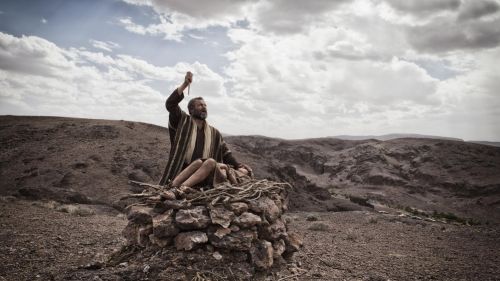
movie-stills
From Noah to Abraham to Moses and the other protagonists, faith in an invisible God who has spoken and given promises, even in the face of impossible odds, is a constant theme in the film. “God is with us”, “God has promised”, and “trust in God” are very frequent lines. The powerful portrayal of faith even in the face of great uncertainty and danger, even death, is a constant theme. We can often read the stories of biblical people ‘knowing the ending’ and not realizing the great struggle they would have had in maintaining their belief over periods of years with no discernible action by God. Yet the series highlights how faith is always proved right in the end, as God is always faithful to those who trust in Him.

Most of the time, God’s presence, words, and actions are explained through the human protagonists. This is ultimately a smart decision, since many would object to any depiction of God, and the ‘disembodied voice’ often comes across as cheesy.

There are a few exceptions however. When Abraham has the three visitors who promise Isaac’s birth, one of them, whose face is never shown, is clearly the actor who will later portray Jesus. This is actually a theologically sophisticated portrayal, as many believe that the Old Testament theophanies (places where God revealed Himself in a visible form) were appearances of the Second Person of the Trinity, who of course was to be incarnate as Jesus Christ.

The Gospel in The Bible

The Bible clearly presents sin as what broke our relationship with God, and what causes God's judgment. Characters throughout the series are saved by faith in God, and in the New Testament, faith in Jesus. The episode which includes Jesus’ ministry draws the dichotomy between the Pharisees, who believed that strict adherence to the Law was what led to salvation, and Jesus and His disciples, who emphasize faith in God and forgiveness for sinners. Substitutionary atonement isn't spelled out in detail, but it is made clear that the Resurrection was the basis for the disciples’ early preaching about Jesus.

A sweeping history

It’s common for people to read the Bible as a disjointed narrative, as if each book and story of the Bible were disconnected from the rest of Scripture. One thing that The Bible does really well is connect the history of Scripture as one continuous whole. Abraham is Noah’s descendant, and the Israelite slaves in Egypt are Abraham’s descendants, and so on. A few lines of well-chosen narration continue this flow through gaps of hundreds of years. And there’s no hint that some characters are less historical than others.

One exception to this, surprisingly, was Jesus. I felt the series could have done a slightly better job of connecting Jesus to the rest of the narrative as David’s descendant and successor (the Eden part was far too short to include the ‘seed of Eve’ prophecy, or that would have been another possibility).
The depiction of the various protagonists may help people, especially those unfamiliar with Scripture, to see the characters of the Bible as real people, who took part in real historical events. Even the ‘bad guys’ were appropriately sympathetic (with the understandable exception of Herod the Great, who was as disgusting in real life as he is portrayed in the series).

The Bible—worth watching

The Bible is a brilliant production that brings the history of the Bible to life, and it’s immensely encouraging that a series of this caliber will be airing on The History Channel. No series could possibly perfectly convey the message of Scripture given the constraints of the medium. But I believe The Bible could expose people to these stories for perhaps the first time. People who won’t pick up a Bible will perhaps switch on The History Channel. And if we as Christians ‘get behind’ efforts like these, perhaps we will see more high-quality productions based on the biblical message.
Creation.com reaches millions of people each year–many of these aren’t believers in our Creator and Savior Jesus Christ. How will we reach them without your support? Please consider a small gift today.

Wednesday, February 27, 2013

The Bible and Capital Punishment - Greg Koukl

Stand to Reason

The Bible and Capital Punishment

By Gregory Koukl

of Stand to Reason (http://www.str.org/site/News2?id=5164)

divider

I. The Bible and Capital Punishment


    A. Capital punishment was commanded by God in the Old Testament.

      1. It preceded the Mosaic Law.

        Gen 9:6 Whoever sheds man's blood, by man his blood shall be shed, for in the image of God He made man.

      2. It was based on the dignity of man, i.e. man's transcendent value.

        Gen 9:6 Whoever sheds man's blood, by man his blood shall be shed, for in the image of God He made man.

      3. It was commanded in the Mosaic Law.

        a. Twenty-one different offenses called for the death penalty in the Old Testament.

        b. Only three include an actual or potential capital offense, by our standards.

        c. Six are for religious offenses.

        d. Ten are for various moral issues.

        e. Two relate to ceremonial issues.

      4. "But King David wasn't put to death for his capital crimes."

        a. David understood what justice demanded in this case: "As the Lord lives, surely the man who has done this deserves to die." 2 Sam 12:5

        b. If God chose to set aside punishment, that doesn't mean the punishment is unjust when it is executed. God was the one who required capital punishment in many instances.

    B. Capital punishment was assumed in the New Testament.

      1. God ordains governing authorities:

        a. Jn 19:11 Jesus answered [to Pilate], "You would have no authority over Me, unless it had been given you from above."

        b. Rom 13:1-2 Let every person be in subjection to the governing authorities. For there is no authority except from God, and those which exist are established by God. Therefore, he who resists authority has opposed the ordinance of God; and they who have opposed will receive condemnation upon themselves.

        c. 1 Pet 2:13-14 Submit yourselves for the Lord's sake to every human institution, whether to a king as the one in authority, or to governors as sent by him for the punishment of evildoers and the praise of those who do right.

      2. Those governments may practice capital punishment.

        a. Rom 13:3-4 For rulers are not a cause of fear for good behavior, but for evil. Do you want to have no fear of authority? Do what is good, and you will have praise from the same; for it is a minister of God to you for good. But if you do what is evil, be afraid; for it does not bear the sword for nothing; for it is a minister of God, an avenger who brings wrath upon the one who practices evil.

        b. Acts 25:11 If then I am a wrongdoer, and have committed anything worthy of death, I do not refuse to die; but if none of those things is true of which these men accuse me, no one can hand me over to them. I appeal to Caesar.

    C. Jesus' ethic of love and forgiveness doesn't disallow capital punishment.

      1. "But Jesus would forgive."

        a. This argument proves too much. 

          1) It becomes an argument against any punishment what-so-ever.

          2) What should we do with the criminal we've forgiven?

          a) Life in prison instead of capital punishment?

          b) But Jesus would forgive.

        b. Jesus never challenged the validity of the death penalty. 

          1) In Jn 8:3-11, for example, there were no witnesses left to testify against the woman caught in adultery (the Law required at least two witnesses).

          2) Jesus actually upheld the Law here, He didn't abrogate it, but He did so in a way that wouldn't allow the evil designs of the Scribes and Pharisees to be accomplished. 

        c. Jesus asked God to forgive, not Caesar; He didn't suggest civil punishment or capital punishment was inappropriate.

        d. We must argue for the coherence and consistency of both Testaments. 

          1) The question is not, "Was Jesus right or was Moses right?"

          2) We must also factor in Paul and Peter.

      2. "Jesus was crucified."

        a. I'm not sure what the point is here? Yes, Jesus was the victim of capital punishment, but what follows from that?

        b. The real issue regarding Jesus was not capital punishment, but His innocence.

          1) Peter assails the act of handing over an innocent man to godless executioners.

          2) Men of Israel, listen to these words: Jesus the Nazarene, a man attested to you by God with miracles and wonders and signs which God performed through Him in your midst, just as you yourselves know--this Man, delivered up by the predetermined plan and foreknowledge of God, you nailed to a cross by the hands of godless men and put Him to death. (Acts 2:22-23)

      3. But what about forgiveness?

        a. God's mercy is always available in His court. 

        b. Man's court is another matter, governed by different biblical responsibilities.

    D. One simply can't say that capital punishment is patently immoral on biblical grounds.

      1. Jesus did not "abolish the Law," 

        He fulfilled it, but not in the sense that all laws are wiped from the books. Then we would have no punishment for any biblical crimes.

      2. Matt 5:17-19

        Do not think that I came to abolish the Law or the Prophets; I did not come to abolish, but to fulfill. For truly I say to you, until heaven and earth pass away, not the smallest letter or stroke shall pass away from the Law, until all is accomplished. Whoever then annuls one of the least of these commandments, and so teaches others, shall be called least in the kingdom of heaven.


II. Retributionism vs. Rehabilitationism


    A. Each position is based on a particular view of man.

      1. Rehabilitationism

        a. Man is man sick, needing healing.

        b. Man is a machine needing fixing.

      2. Retributionism

        a. Man is a free moral agent who makes choices for which he can be held responsible for.

        b. Man is worthy of praise, resulting in reward, or blame, deserving punishment.


    B. The case for retributionism

      1. Man a free moral agent.

        a. He is capable of choosing good or bad behavior.

        b. He may be influenced by his environment, but not ultimately controlled by it.

        c. We have an immediate awareness of our moral natures, that we freely make moral choices.

        d. It seems to make sense to praise and reward good behavior. If we're not responsible for our choices neither blame nor praise make any sense.

        e. If we are not free agents, then we are determined and therefore not responsible for our behavior, either good or bad. B.F. Skinner was right; we've got to bite the bullet and realize that we're "beyond freedom and dignity."

      2. Crime is not pathological, deserving rehabilitation, but moral, deserving punishment.

        a. The goal of justice is penal, not remedial, moral, not therapeutic.

        b. Two purposes of capital punishment:

          1) Justice demands punishment of the guilty.

          2) Goodness demands protecting the innocent in society.

            a) "Capital punishment is to the whole society what self-defense is to the individual." The Ethics of Life and Death J.P. Moreland, p. 115.

            b) Dennis Prager: "We have a war going on here between murderers and society, but only one side is allowed to kill."

      3. The punishment should fit the crime (lex talionis).

      4. Capital punishment fits capital crimes (crimes that involve the loss of life).


    C. Objections to retributionism

      1. Arguments that prove too much.

        a. Many arguments against capital punishment prove too much because they apply with equal force against any punishment at all.

        b. "Capital punishment is applied unfairly."

          1) Even if this were true, the injustice here applies to those that got away, not to those that got punished. It's never unjust to punish a guilty man if the punishment itself fits the crime (lex talionis). The injustice is remedied by applying it more often, not less.

          2) Better unequal justice than no justice at all.

          3) If one man is paid for a job (he gets what he deserves) and another isn't, how do you rectify the inequity? You don't take away what the first man deserves, withholding his pay because the second man didn't get paid. That would double the injustice.

        c. "Innocent people get condemned."

          1) This is a criticism of any system of justice, not a particular type of punishment. Life is flawed, not capital punishment.

          2) Why must we accept a philosophy that says it's better for 100 guilty people to go free than for one innocent person to be condemned?

          3) Guilty people repeat crimes that injure and even kill other innocent people.

          4) "But death can't be undone." No punishment can be undone.

          5) Our attempts at improving justice here must be at the level of the process of adjudication making any determination of guilt more trustworthy.

      2. Other objections:

        a. "How can you be for capital punishment but against abortion" (the "seamless garment" argument)?

          1) The term "Pro-life" is actually a misnomer. Our case is not for every one's life or every form of life. Pro-lifer's are against the unjust taking of innocent human life, particularly the life of the unborn child.

          2) The right to life is not an absolute; it can be forfeited. This moral right is only prima facie; it stands only until challenged by some greater law, like justice or protecting the lives of the innocent.

          3) We also have a right to freedom, but it can be properly overridden with incarceration when certain conditions are met.

          4) An unborn child has committed no crime that forfeits its life.

        b. "Capital punishment is cruel and unusual."

          1) It's not cruel and unusual, but rather the exact punishment that fits the crime.

          2) This is an appeal to the language of the Bill of Rights, but the ones who wrote those words believed in capital punishment. If one wants to redefine the term for modern times, then he cannot argue from the Bill of Rights itself, because that has the old definition.

        c. "Capital punishment doesn't work; it doesn't deter crime."

          1) It always deters the offender. Dead people don't commit more crimes.

          2) If it lacks in deterrence, it might be because it is not widely exercised or not done speedily enough to be a threat.

          3) The principal goal of capital punishment is not deterrence, but punishment. In that way it works every time.

        d. "Why not a life sentence?"

          1) Confuses a life sentence with a death sentence.

          2) It's unjust (doesn't fit the crime) because the criminal only loses liberty, not life.

        e. "This kind of death is undignified."

          1) In one sense, all death is undignified.

          2) Argues only against certain aggravated forms of capital punishment and not capital punishment itself.

          3) In the final analysis, the question is not the dignity of death, but its equity or justice.

        f. "There's no opportunity of to reform the criminal." Justice is the goal of punishment, not reform.

        g. "Capital punishment violates human dignity."

          1) It is specifically because of man's value and dignity that we punish his moral wrongdoing. We don't punish animals for stealing or killing (we don't punish them, we remove them for our safety).

          2) We hold men morally responsible because of dignity.

          3) "It is based on the assumption that normal adult beings are rational and moral beings who knew better, who could have done otherwise, but yet who chose to do evil anyway, and who therefore deserve to be punished." JPM p. 118

          4) Arguably it is undignified to force rehabilitation on free moral agents who don't want it.

        h. Roman Catholic objections

          1) The Catholic position against capital punishment is somewhat ironic given their position on purgatory, in which even when God forgives a sinner, still he must suffer for his own sins.

          2) What of the practice of penance?


    Study Exercises:

    1. Where is capital punishment first mentioned in the Bible ?
    2. What is the biblical rationale for capital punishment ?
    3. Show how capital punishment was assumed in the New Testament.
    4. Does Jesus' ethic of love and forgiveness disallow capital punishment?
    Give reasons for your answer.
    5. What is the basic view of man behind rehabilitationism ?
    Retributionism ?
    6. How are the notions of praise and blame related?
    7. Reply to the arguments that capital punishment should be abolished because it is applied unfairly and innocent people may be condemned.
    8. Refute the "seamless garment" argument.
©1994 Gregory Koukl. Reproduction permitted for non-commercial use only.
For more information, contact Stand to Reason at 1438 East 33rd St., Signal Hill, CA 90755
(800) 2-REASON (562) 595-7333 www.str.org

Tuesday, February 26, 2013

WHEN WAS--IS the SALVATION of ISRAEL to OCCUR?

Great little article here.

WHEN WAS--IS the SALVATION of ISRAEL to OCCUR?

PAST--PRESENT--FUTURE

Jeff  Miztah  Rogers, Yahoo! Contributor Network

The promise was given by God through Isaiah:

Thus saith the LORD, In an acceptable time have I heard thee, and in a day of salvation have I helped thee: and I will preserve thee, and give thee for a covenant of the people, to establish the earth, to cause to inherit ...the desolate heritages; Isaiah 49:8

Read the rest here.

Sunday, February 24, 2013

Peaceful Loving Verses from the Quran


Since Islam is such a peaceful religion, I thought I would share some loving verses from the Qur'an

What the Qur’an says about Christians and Jews


  1.  "Slay the unbelievers wherever you find them." Surah 2:191
  2. "Kill the Jews and the Christians if they do not convert to Islam or refuse to pay Jizya tax." Surah 9:29
  3. "When opportunity arises, kill the infidels wherever you catch them." Surah 9:5
  4. "Terrorize and behead those who believe in scriptures other than the Qur'an." Surah 8:12

Saturday, February 23, 2013

The suffering brothers and sisters of aborted children

The suffering brothers and sisters of aborted children 
from http://liveactionnews.org/the-suffering-brothers-and-sisters-of-aborted-children/ (there are some great testimonies in the comments to read)


The suffering brothers and sisters of aborted children


Siblings are meant to be together. (Photo credit: TimothyJ on Flickr)
Abortion is anything but a simple choice. It affects not just the child who dies in an unimaginable way. It affects not just the mother who suffers through the abortion or the father who could do nothing to stop it. Abortion affects the family at large – grandparents, aunts, uncles, cousins, and brothers and sisters.
It can be a very strange thought to wonder why you were chosen to live while your brother or sister was chosen for death. Why did you survive? What would your sibling have been like, acted like, looked like? Would he or she have resembled you? Become your best friend? Years of memories you should have had were wiped out before you ever knew that your brother or sister should have existed. Indeed, abortion is anything but simple for the brothers and sisters of aborted children.
Barb, who has worked with the AAA Center for Pregnancy Counseling for nearly thirty years, writes this:
Abortion teaches children that they have worth because they were conceived in the right conditions and at the right time; that they have value because their parents want them. Up to 50% of all American children have lost a brother or a sister to abortion, making it much more likely that they live with a performance view of love: I was born because I was wanted therefore I better perform so they will continue to love me.
Barb also talks about the reality of survivor’s guilt among siblings of aborted children and about the horrors of selective reduction, in which one or more babies in a multiple pregnancy (twins, triplets, quadruplets) are selected for death and aborted while the rest are allowed to live. Mark I. Evans, a doctor known for doing selective reductions, explains the heartache from his own perspective. Imagine the thoughts of surviving siblings once they discover what happened to their brothers or sisters, right next to them in the womb:
It’s a very hard procedure, because the baby is moving, and you are chasing it. That is what is very emotional — when the baby is moving and you are chasing it.
Angie (not her real name) is the sister of two aborted children. She was the oldest child and the only girl allowed to be born. Her only full biological sibling was aborted in a back-alley procedure, just a few short years after Angie’s birth. Angie’s mother then went on to have two sons – Angie’s half-brothers. They were five and nine years younger than her. When Angie’s mother got pregnant for the last time, she decided she was too tired to have a fourth child. So she flew to New York, where elective abortion was legal at the time, and aborted Angie’s last sibling.
The siblings of aborted children sometimes find it hard to deal with their trauma. (Photo credit: James Dennes on Flickr)
Angie will always have to wonder why she was allowed to live when her brother or sister was subjected to a crude back-alley death. Would she have ever had a sister? Would her real father have been able to stay in her life if her full brother or sister had lived? What would it have been like to have had a sibling close in age to her; to grow up with as a friend? Would she have been a second mother to her youngest sibling, just like she was to her youngest living brother? What made the difference? Why was she saved, when others died?
While Angie may never get all of her answers, it’s important that she – and other men and women like her – find an outlet for their painful questions. There are several wonderful healing ministries for men and women who have experienced abortion, but it’s much harder to find a support group for siblings of aborted babies.
Renee – an oldest daughter just like Angie – shares these sentiments on her blog, Surviving Sibling. She writes about her very personal story – her struggle with her brother’s untimely death, her love for her mother, and both her and her mother’s decisions to get involved in the pro-life movement.
Apparently she chose that night [the night of her mother's abortion], because going out, then, would not likely arouse suspicion. Years later it brought me such pain to think that that night before she left, when I gave her a hug, I also hugged my little brother inside, but the next time I hugged her, it was just her alone. L How sad she must have been. And how innocent and unaware I was. …
For a while after finding out, I had such a deep sadness that I could not identify at first. I felt like I did when I lost one of my nursing home friends, but nobody had recently died. What was up? Then I realized it was my brother. I was grieving the loss of a little sibling, that up until then had not existed (that I was aware of). How strange. How could I possibly feel so strongly for someone I never met, or even knew about? As I mentioned before, I am not an emotional person, so these feelings were extra unappreciated. I felt stupid for grieving 11 years later. He was long gone, I shouldn’t feel anything. But, that’s not how it works. Over time, I felt that sadness less frequently, but still, 6 years later I feel twinges at times. I have also, at times, felt completely at peace with our situation, and at other times, have seriously forgotten about him. That, I believe, is often a defense mechanism.
Renee has decided to reach out to other siblings of aborted children through her blog and through two Facebook groups she’s created: Abortion Hurts Siblings and Others and a “secret” group called “I Lost a Sibling to Abortion.” If you are suffering from the loss of a sibling through abortion – or still processing it – check out Renee’s blog and Facebook groups. Losing a sibling through abortion is a legitimate cause for grief and pain, and it’s important to find healing as much as possible.
Abortion Recovery International also helps siblings of aborted children find healing. You can call them at 1-800-395-HELP.
We must admit that abortion causes only suffering for the brothers and sisters of an aborted child – whether they come before or after the abortion. As Barb says:
I think one of the most difficult things for me to face is a woman who is attempting to justify an abortion for the sake of her other children. I always want to tell them…the best thing for her little ones is to have a brother or a sister. In fact, explaining to sons and daughters a few years in the future as to why they aborted their sibling will probably be the most difficult thing they will ever do[.]

Thursday, February 21, 2013

Christians Beaten for Worshipping in India

Anti-Christian Violence Spreading Across India « Persecution News


Anti-Christian Violence Spreading Across India

ICC Note:
Two more incidents of anti-Christian have been reported coming out of the state of Madhya Pradesh. Hindu nationalist groups like RSS are stoking religious tension into outright religious conflict. Two pastors were attacked and beaten in separate incidents this week. In each case the pastor was arrested and jailed after being beaten. In both cases the Hindu radicals broke into the homes of these pastors. Are pastors in India safe?
2/21/2013 India (AsiaNews) - Two more anti-Christian incidents in Madhya Pradesh illustrate the latest trend among Hindu fundamentalists. In addition to filing false charges over forced conversions, they are now attacking Christians in the privacy of their homes even though "praying in one's home is not a crime," Global Council of Indian Christians (GCIC) Sajan George said.
Pentecostal Christians were attacked in two separate incidents on 16 and 18 February. Last Monday, members of the Hindu ultranationalist Bajrang Dal stormed the home of a man, Hiralal, in the village of Roshni, where they beat up Rev Iliyas Buck who was leading Bible studies. After the attackers called police, the clergyman was taken into custody and charges of forced conversion were laid against him. He was eventually released a few hours later.
Last Saturday, Hindu nationalist from the Bajrang Dal and the Rashtriya Swayamsevak Sangh (RSS) broke up a prayer meeting in the village of Gulai. After beating up the clergyman conducting the service, Rev Isaac, they took him away later in the evening to Khalwa where they resumed their beating. Later, they handed him over to police who kept him in jail overnight.
Although the Indian constitution recognises freedom of worship, incidents of this kind have become more frequent across the country.
...

66 Churches Burned Down in Burma since June 2011

Sixty-six Churches Burned Down in Burma Since June 2011 « Persecution News


Sixty-six Churches Burned Down in Burma Since June 2011

Religious persecution, rape still evident in Kachin State
ICC Note: In this shocking report a human rights organization working in Burma reveals that sixty-six churches have been burned down by the Burmese military since the beginning of a military offensive in June 2011. The Burmese military, which is made up completely of Buddhist troops, has been at war with the ethnic Kachin, who are over 90% Christian, for decades. A cease-fire between the groups ended when the Burmese military attacked again in June 2011. According to this article they have waged “unequal warfare” on Christian holy days and torched sixty-six churches in just a year and a half.  
2/15/2013 Burma (MN) -Sixty-six Christian churches have been burnt down in Kachin state since the conflict erupted in June 2011, according to the Kachin Women’s Association of Thailand (KWAT), a figure that is backed by Myitkyina-based Kachin Baptist Convention.
…
According to website CatholicCulture, spokesman Bishop Francis Daw Tang of Myitkyina said, “As a church, we walk with our displaced people, watch their lives being destroyed by war, their families fragmented by the depressing life in the displaced camps.”
He accused government forces were waging “unequal warfare” on Christian holy days.
Kwat’s Marip said there are now 100,000 people displaced by the conflict in Kachin State, 60,000 of whom are sheltered at the Sino-Myanmar border or other areas under Kachin rebel control, and 40,000 in areas under government control.
Marip said her organization had continuing evidence of systematic rape by Myanmar troops against Kachin and other ethnic women. She said KWAT had recorded 30 incidents where 64 women or girls had been sexually assaulted in Kachin State since the conflict began.
…
“Half of those women raped were killed afterward,” she said.
…